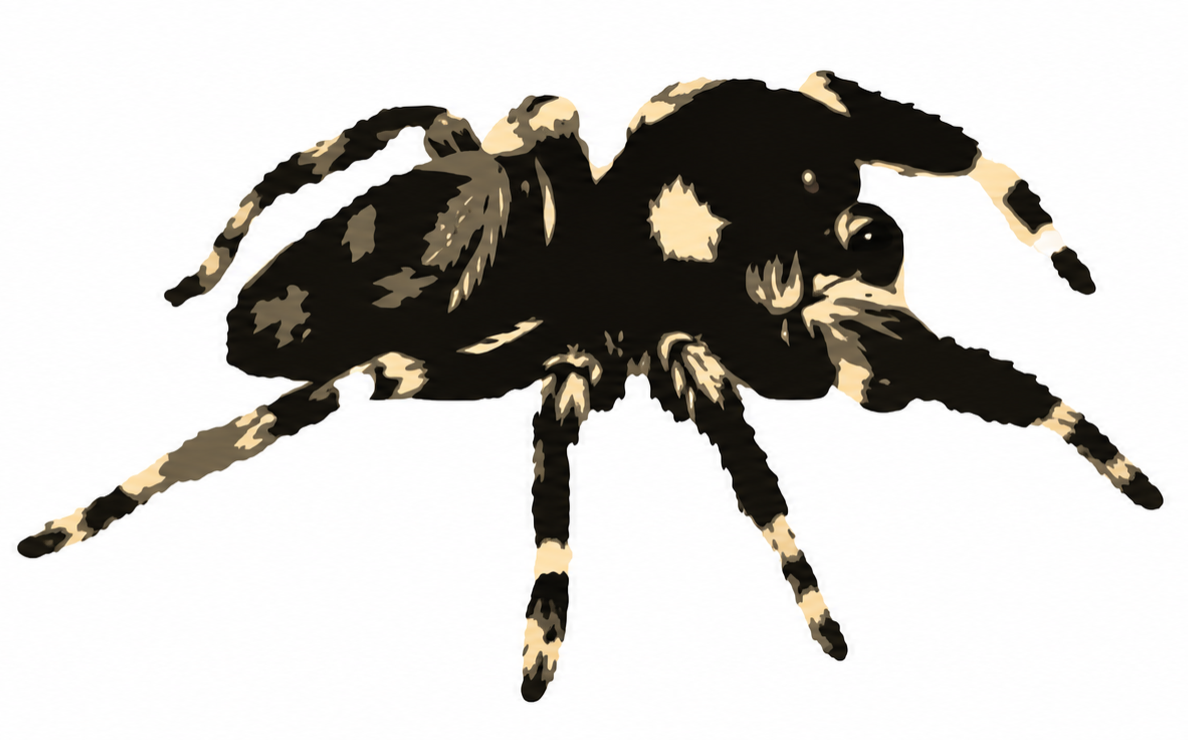

Caring for your Phidippus
Housing
The container that you received your spider in can be used to house your jumper, but you will likely get more enjoyment out of your spider if it's in a larger container. The container that you choose to use should be vented to allow for fresh air and ventilation of humidity. A clear plastic container such as a spice jar is good for housing. A few small holes at the top and sides will work fine. Be careful when making the holes. The use of a drill with a small bit works well for this.
If you choose to use a "critter keeper" from your local pet store, be sure that your spider is large enough to not escape through the slots. You may need to tape these from the inside to prevent escape while your jumper is still young.
If you place a strip of masking tape vertically inside of the container with one end up to the top, the spider will almost always make its sac on the tape. Blue tape seems to work especially well.
Keep the container clean and dry. Having the lid at the bottom makes cleaning much easier. Do not allow your spiders to cohabit in the same enclosure. This often leads to one of them having a bad day. Even adult males and females will not get along indefinitely.
The important point to remember is that if you choose to keep your spider in a relatively large container, make sure that the spider has a place that it can make its sac without it being ripped open each time you open the container.
Handling
Certain species, and even individuals within the same species, tolerate physical handling more than others. It's very much a case-by-case basis. Some individuals will never tolerate resting on your hand, while others will have no problem hanging out with you. Be careful not to injure your spider. Trying to quickly close your container to keep the spider inside may lead to a two-piece spider.
It's generally okay to allow your spider to come outside of its container. A flat-edged container, such as a tic tac container, works well for capturing and transporting your jumper. Your spider leaves a trail of silk wherever it goes. Learn to manipulate this safety line when handling your spider. Even if you don't see any silk, expect that it's there, so be sure to break it off or wrap it around the edge of the container when placing your spider back into its enclosure. You will get used to this, and it will become second nature after a little practice.
When your spider jumps from your hand, it will often hang for a moment, and then climb back up to your hand if it was too far from the ground. Be careful when handling fat gravid females. They will become so plump that if they fall to the ground they may bust open, which is always fatal.
Bites are usually very mild, but they can sometimes be a bit painful. The spider will typically warn you if it feels threatened. If your spider raises its legs and opens its fangs in a defensive posture, just give it some space. It isn't happy.
Feeding & Watering
When you receive your spider, give it water. It will be thirsty. Very light misting or spattering of small droplets of water is one way of giving your spider water, but be sure to never over-water. A wet container is not healthy for your spider, so it may be necessary to dry some of the water from the container. Give water at least twice a week. A moist paper towel is another method of giving water, but the spider may not be aware that it is in the container if it is in its sac.
You can feed your spider daily until he/she becomes "plump". Immature males and females will both eat voraciously, but once they are adults, the males eat much less than the females. If your spider does not show an interest in feeding, remove the prey immediately.
Never try to feed your spider prey that may injure your spider. Generally, prey such as crickets and grasshoppers should be about the same size as the spider or smaller to not risk injury. The spider will go after much larger prey sometimes, but you risk your spider losing a leg or worse when the insects are large. However, prey such as moths or mealworms can be significantly larger than the spider.
Be careful feeding your spider other spiders. A smaller spider that makes a web can kill a jumper if given a chance to make a web in the container. I've seen an adult female P. regius die after consuming a brown widow, so be careful what you feed it. Your spider will not have an appetite after molting or while waiting to molt.
Molting
A well-fed Phidippus will typically shed its skin about every three weeks as its maturing. The spider may make a shed-sac up to a week or more prior to molting. A shed-sac is normally a thick, white sac that is built to protect the spider while waiting to molt. They may remain in this sac for a couple of days after molting.
Do not force your spider from a thick sac that it has made if it is still maturing. If it tries to molt outside of its sac, there may be complications, which are often fatal for the spider.
After molting, your spider will need water. Make sure that some water droplets fall onto its sac. If not given water within a few days, it may die of dehydration. Allow the spider to remain in its sac for at least a day after it molts to allow the new skin to harden.
Breeding
Make sure that the spiders are well-fed! A hungry female will not be very interested in mating. Make sure that both male and female are adults. A sub-adult female will show no interest in mating. She will typically run from the male.
Once you do get successful mating, do not allow the spiders to cohabit for a long period of time. Sometimes the female tolerates the male for several days, but only until she gets hungry.